

Planting in Potters Fields Park
Potters Fields Park is a unique green open space by the Thames next to Tower Bridge. With its spacious lawns, whispering trees, quiet walkways and colourful wildlife-friendly gardens, it offers an oasis in the middle of London.
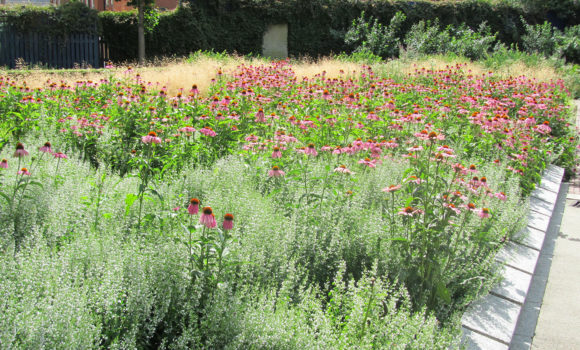
From herbaceous perennial beds filled with vivid echinacea and wild peonies in summer to deep-purple buttercups and spiky snake root in the winter, Potters Fields Park has always been visually arresting all year round. Our planting scheme and its sustainable management regime is a significant local resource for foraging and nesting insects, as well as humans.
The park’s redesign in 2008 by GROSS MAX was influenced by renowned Dutch plantsman Piet Oudolf, whose designs are celebrated for their use of herbaceous perennials and grasses, chosen as much for their structure as for their flower colour. Potters Fields Park was the first London park to introduce Oudolf’s trademark ‘prairie planting’ – a landscaping style that relies on sweeping grasses usually seen in the tallgrass prairies of central and eastern North America. Alongside the wild planting of ‘Culvers Root’ and ‘Lambs Ear’ the beds have provided plenty of interest throughout the year. (You can see the original planting plan below)
In recent years, the planting had shown significant degradation. Some species had naturally died out, some had thrived at the expense of others and some, although innovative at the time, had proved unsuitable in the long term.
A new sustainable planting scheme
In 2023, the Trust commissioned landscape designer Darryl Moore, Director of Cityscapes, to undertake a comprehensive review of the beds, assessing their original design, plant selection, biodiversity, soils, irrigation, maintenance practices, and effects of climate change. We chose to design for the future, increasing biodiversity, reducing water use and becoming more resilient to climate change.
In January 2025, we started updating our beds with the new scheme. Phase 1 focused on the beds closest to the main entrance on Tooley Street, and features many pollinator-friendly plants, which are drought tolerant and will improve the park’s biodiversity.
In early 2026, Phase 2 was completed. This included an upgrade to the irrigation system, enabling more control over timing and flow rates to manage water use more efficiently.
The new beds use a free-draining mix of recycled sand and crushed concrete. mounded to create visual interest and allow variations in moisture and light levels for greater plant diversity. They also encourage deeper root growth which reduces the need for additional watering as plants become established.
A matrix planting approach has been adopted, using a diverse mix of native and European species selected for their drought tolerance, value to pollinators, and ability to self-seed and spread naturally. Approximately 15,000 plants have been planted, and there are now c. 115 plant species within the park, compared to 66 previously.
We’ll be providing the plant list and more images soon, as the beds continue to flourish.

Click image to view planting plan PDF (2.7Mb) in more detail
Our Head Gardener’s Top Plants
Our Head Gardener, Bryan, loves the variety of plants in Potters Fields, as they provide interest, colour and texture all year round; here, he picks out just a few of his long-time favourites.
He’s always happy to stop for a chat and to answer any questions you have about individual plants or the parks in general.
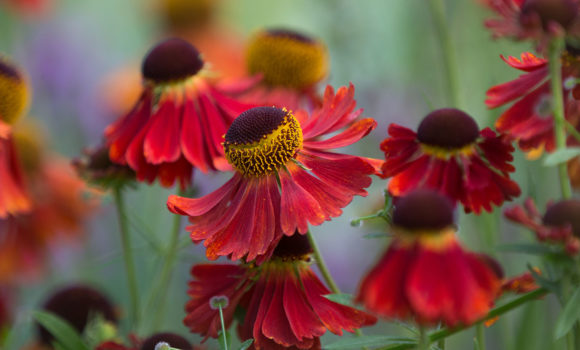
Echinacea
Echinacea tennesseensis – the Tennessee Coneflower – is a flowering plant in the sunflower family. During the summer months, the echinacea flowers can be seen in their hundreds across the planting beds. Echinacea is a tall perennial plant renowned for its healing properties; its active microbial substances are commonly used to combat flu and cold symptoms.
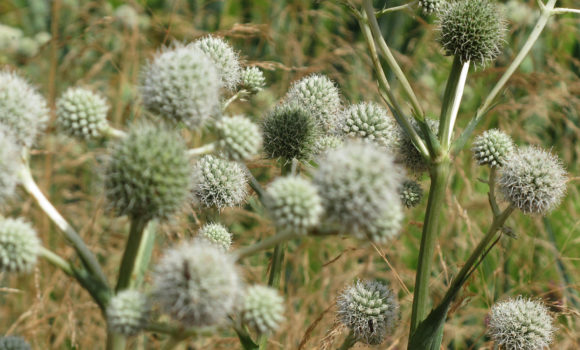
Button Snakeroot
Eryngium yuccifolium – Button Snakeroot or Rattlesnake Master – is a herbaceous perennial of the parsley family. Its hardy stems and silver spiky flowers create structure in our planting design and break up the softness of our grasses. The common names of ‘Snakeroot’ or ‘Rattlesnake Master’ originate from its early use by Native Americans as a snakebite remedy.
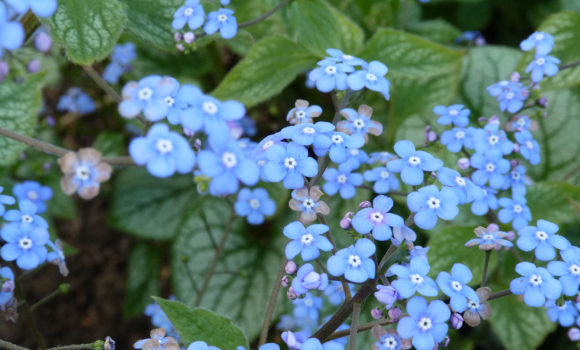
Siberian Burgloss – ‘Jack Frost’
Brunnera macrophylla – Jack Frost – is a perennial evergreen of the forget-me-not family. It is characterised by its large mottled silver, heart shaped leaves and sprays of blue flowers in Spring. Their striking colour is one of the earliest seen on the Park each year and marks the start of Spring in our calendar.
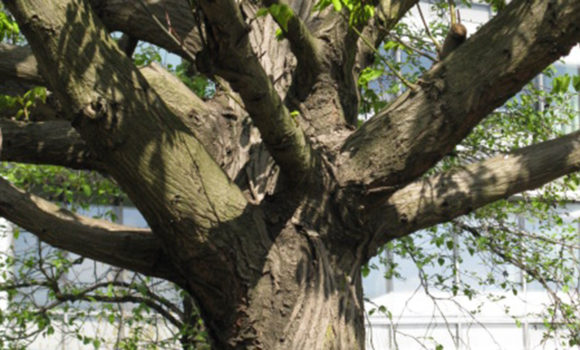
Wingnut Tree
Pterocarya fraxinifolia – the Wingnut Tree – is a species of tree in the walnut family. It has an ancient feel and the species’ origins date back to pre-historic times (Pilocene Age). The most distinctive aspect of the Wingnut is its drooping catkins, which hang down in clusters in the summer and create winged fruit in the autumn.
Lesser Calamint
Calamintha nepeta – Lesser Calamint – is a perennial species of plant in the mint family. Calamintha produces small clusters of lipped white flowers in the summer and autumn and produces a strong minty fragrance. It is sometimes used for herbal teas and the flowers are highly attractive to bees (giving our honey a slight minty taste!)